
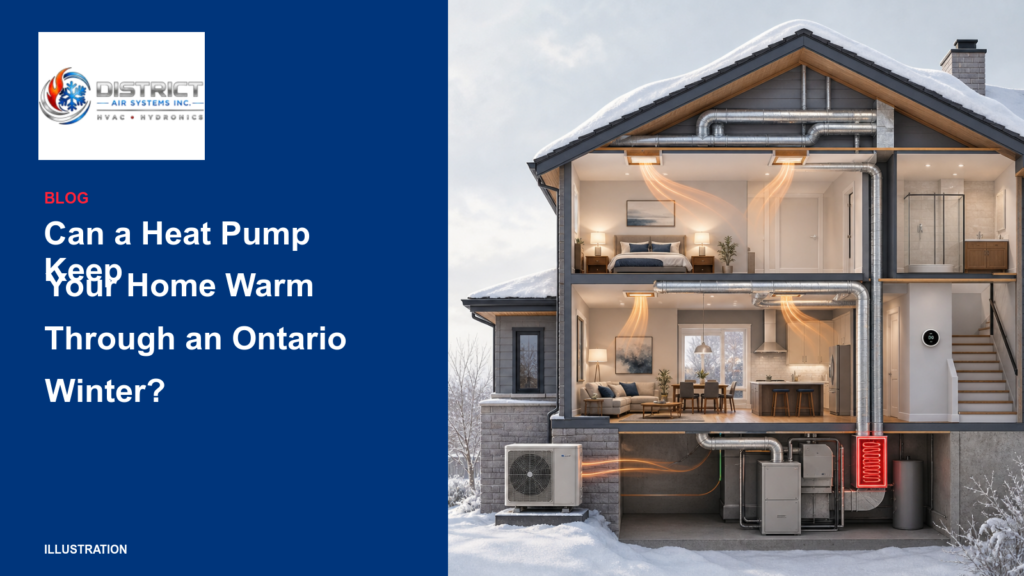
Yes—many cold-climate air-source heat pumps can keep an Ontario home warm through winter. But no equipment should be judged by its nameplate alone. The result depends on the model’s low-temperature performance, the home’s heat loss, the ductwork or indoor-unit layout, the electrical setup and whether supplemental heat is part of the design.
Natural Resources Canada says cold-climate air-source heat pumps can operate in outdoor temperatures as cold as -30°C. That does not mean every model provides its full rated heating capacity at that temperature. As outdoor temperatures fall, heating capacity generally decreases, and some systems need supplemental heat during very cold weather or defrost cycles. Natural Resources Canada’s heat-pump guidance explains why the specific equipment and installation matter.
How a heat pump heats a home in cold weather
An air-source heat pump transfers heat from outdoor air into the home. Even cold air contains heat, but less heat is available as the temperature drops. The system therefore works harder and may deliver less heating capacity during the coldest periods.
Some cold-climate models are designed to maintain useful heating performance at lower temperatures than conventional air-source equipment. The operating range, capacity and efficiency still vary by model. Ask for the manufacturer’s performance data and the proposed system’s AHRI number rather than relying on a general “cold climate” label.
A heat pump may also run for longer periods than a furnace. Its supply air can feel less hot even while the home is being heated normally. A persistent inability to maintain the thermostat setting, however, is a reason to have the system assessed.
What supplemental or backup heat does
Supplemental heat provides additional capacity when the heat pump cannot meet the home’s full heating demand on its own. It may be electric resistance heat, an existing furnace, a boiler or another compatible source.
In a hybrid arrangement, controls decide when the heat pump and the other heat source operate. The changeover point should suit the equipment, the home and the homeowner’s comfort and energy priorities. Backup heat is not automatically evidence of a failed heat pump; it may be an intentional part of the system design.
Natural Resources Canada notes that supplemental heat may also be needed during defrosting. The correct arrangement should be confirmed during design rather than improvised after installation.
What to assess before choosing a heat pump
1. Heat loss and equipment capacity
The contractor should assess the home’s heating and cooling loads, not size the equipment from floor area alone. Insulation, windows, air leakage, layout and planned building-envelope work can all affect the result. Natural Resources Canada recommends recognized sizing calculations and accurate equipment selection.
2. How heat will reach each room
A ducted system uses the existing air-distribution network. The ductwork, blower and airflow may need to support different operating characteristics than a furnace-only system. A ductless system uses indoor units to serve individual rooms or zones, so their number and placement affect comfort.
If some rooms are already colder than others, changing the outdoor unit alone may not solve the problem. Distribution, zoning, insulation and air movement should be considered together.
3. Electrical requirements
Depending on the system and the home, the project may involve new wiring, controls or electrical-service work. Confirm these requirements before ordering equipment. Electrical work and equipment connections should be completed by appropriately qualified professionals.
4. Existing heating equipment
If the home already has a furnace or boiler, ask whether it should remain as supplemental heat. The answer depends on compatibility, condition, controls, fuel and electrical requirements, and how much of the heating load the heat pump is intended to cover.
5. Outdoor-unit location and drainage
The outdoor unit needs adequate airflow and a suitable path for water produced during operation and defrosting. Snow, ice or a blocked discharge path can interfere with performance. The installation plan should account for clearance, drainage and access for service.
6. Current incentive rules
Rebate programs can change or close, and eligibility may depend on the home, equipment, contractor, paperwork and timing. District Air Systems offers rebate guidance, but the official program source remains the authority. Confirm the current rules before signing a contract or assuming a project qualifies.
When should a heat pump be inspected?
Arrange an assessment if the system cannot maintain the requested temperature, indoor comfort changes noticeably, backup heat runs more often than expected, or the outdoor unit has persistent ice, unusual noise or repeated shutdowns.
Those signs can have several causes, including airflow restrictions, thermostat or control settings, drainage, defrost operation, sizing, electrical issues or a component fault. Do not open electrical panels, handle refrigerant or bypass safety controls. Describe what changed, which rooms are affected and when the problem occurs.
Is a heat pump suitable for every Ontario home?
Not necessarily. A heat pump may be a good fit for one home and a poor fit for another unless the distribution, electrical and backup-heating issues are addressed. The practical choices may include a ducted heat pump, a ductless system, a hybrid arrangement, continued use of existing equipment or repair before replacement.
Compare options based on winter capacity, year-round comfort, installation changes, operating priorities, equipment condition and the amount of backup heat required. A lower equipment price is not useful if the system cannot distribute heat where it is needed.
District Air Systems provides heat-pump repair, installation and maintenance support for ducted and ductless systems. The company’s service page identifies poor heating or cooling, icing, noise, short cycling and unexpectedly high energy use as concerns it can assess.
Common questions
Will snow stop a heat pump from working?
Not automatically. The unit needs suitable clearance, airflow and drainage. Heavy snow, persistent ice or unusual operation should be assessed rather than cleared by opening the equipment or bypassing controls.
Does every heat pump need a furnace?
No. Some systems use electric supplemental heat, while others are paired with a furnace or another heat source. The appropriate arrangement depends on the equipment and the home’s heating requirements.
Is cool-feeling air from the vents always a fault?
No. Heat-pump supply air can feel cooler than furnace supply air because the system may deliver heat at a lower temperature for longer periods. If rooms remain uncomfortable or the thermostat setting cannot be maintained, have the system checked.
Plan the next step with District Air Systems
If you are considering a heat pump or dealing with winter comfort problems, gather the equipment model, recent utility information and a short description of what has changed. District Air Systems serves Innisfil and communities across Simcoe County, including Barrie, Bradford, Angus, Alliston and Orillia.
Request service online or call (416) 209-1379. Include your community, system type, affected rooms and whether you have a furnace or another backup heat source. A submitted request is not a confirmed appointment; the team will follow up to discuss availability and scheduling.
Technical references: Natural Resources Canada’s heating and cooling guidance for heat pumps and Natural Resources Canada’s heat-pump guidance.
